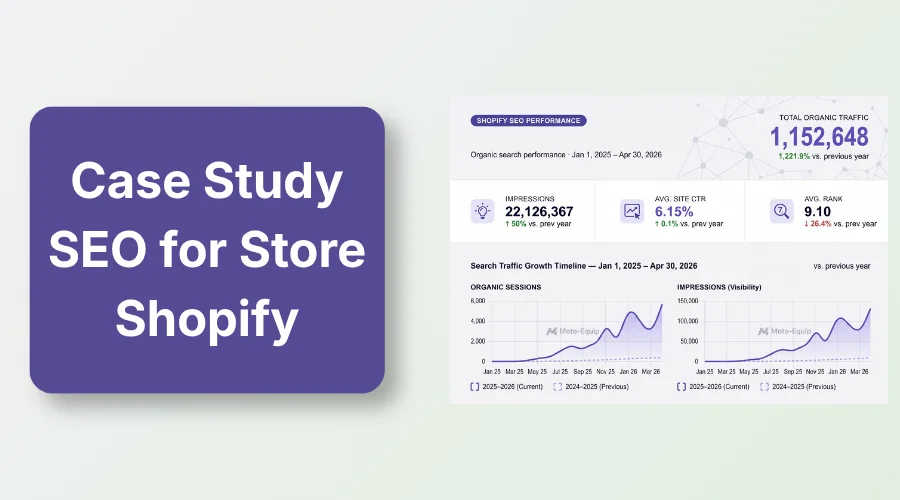
Every verifiable case study SEO for store Shopify proves traffic follows site architecture. Real brands double organic revenue by fixing duplicate collection URLs, optimizing category metadata for commercial intent, and building authority to gain direct citations across Google AI surfaces.
Every real case study SEO for store Shopify shows the same hidden problem. Store owners burn cash on paid ads while their organic search traffic stays flat.
Many merchants watch ad costs climb every month, yet their stores barely show up on Google. Broken links, thin product descriptions, and messy collections quietly choke your sales.
That said, this guide breaks down how real stores fixed these technical traps. You’ll see how simple fixes drove real buyers straight to high-value product pages.
What the Best Shopify SEO Case Studies Have in Common
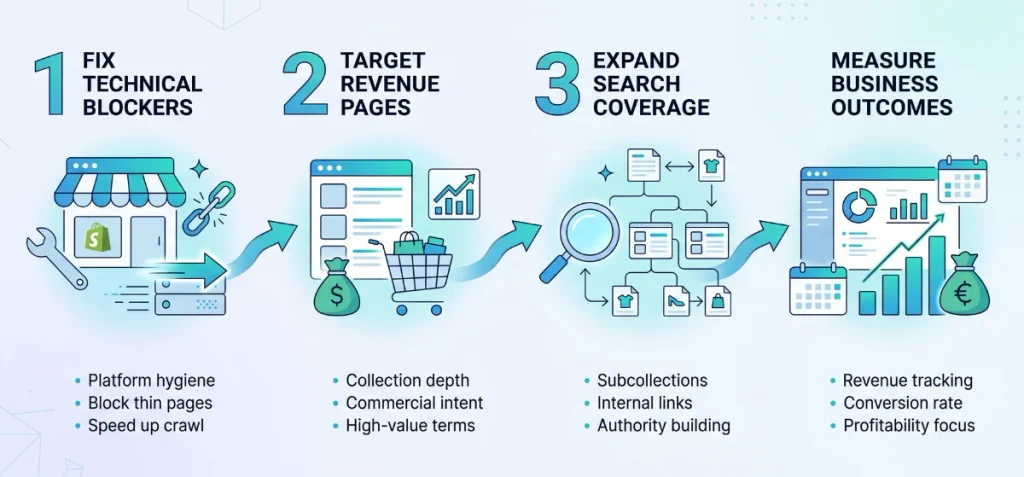
Top-performing e-commerce brands don’t rely on guesswork. They follow a simple, four-part execution framework to turn organic search into their main growth channel.
1. Fix Technical Blockers
Every winning project starts with platform hygiene. Shopify stores frequently confuse search engines with duplicate paths. Liquid themes often link to /collections/.*/products/ rather than the canonical /products/ URL.
Smart merchants clean up these internal links immediately. They block thin tag pages, vendor archives, and unused faceted URLs from Google indexation.
They remove bloated apps, compress large images, and implement clean schema markup. Fast, error-free stores allow search engines to crawl money pages without wasting resources.
2. Target Revenue-Driving Pages
High-growth stores stop chasing low-value informational clicks. They prioritize pages where transactions happen.
Collection pages carry the most commercial weight in e-commerce. Top stores expand basic catalogs into high-intent category structures.
They optimize collections for shoppers ready to buy, targeting specific terms instead of broad vanity words.
3. Expand Search-Demand Coverage
Winning brands build depth around user intent. They don’t stop at a few top-level categories.
They launch targeted subcollections to capture long-tail search queries. These brands publish problem-solving guides that direct users straight to specific product lines.
They strategically insert internal links across the store to pass topical authority from top-of-funnel articles down into bottom-of-funnel catalog pages.
4. Measure Business Outcomes
Great case studies ignore vanity metrics. Deep organic impressions mean very little if checkout revenue stays flat.
Successful store owners track actual revenue, conversion rates, and non-branded search growth.
They monitor organic transaction value directly inside Shopify analytics and GA4. Every SEO task ties back to profitability and reduced ad dependence.
Shopify SEO Case Studies: Results at a Glance
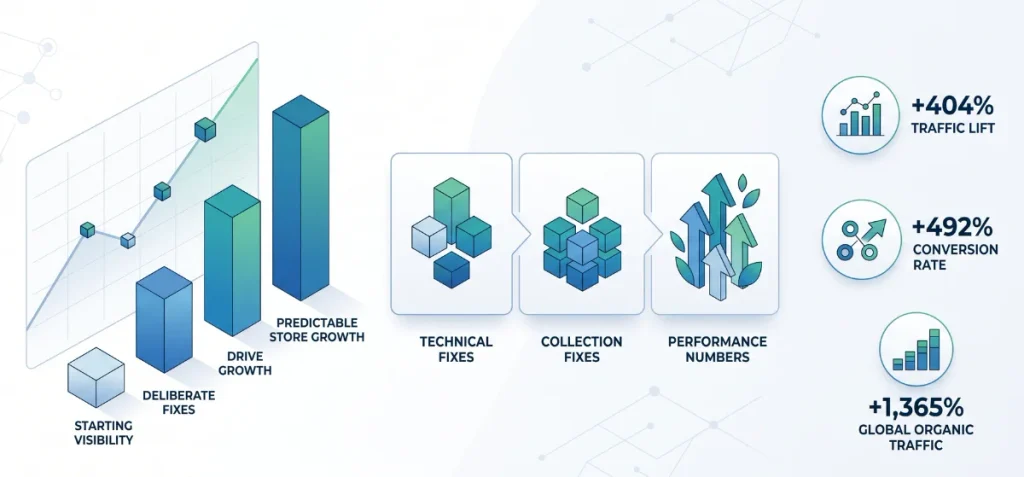
Real performance numbers prove that deliberate technical and collection fixes drive predictable store growth.
| Case | Starting Problem | Main SEO Move | Result | What to Learn |
| VIM&VIGR | Weak non-branded visibility | Architecture overhaul, PDP updates, digital PR | +404% traffic lift, +492% conversion rate (Break The Web) | Systems compound across the catalog |
| Gisou | Weak international and non-branded reach | Collection intent mapping, content clusters, internal links | +1,365% global organic traffic (Break The Web) | Search intent scales across borders |
| Trendy Toddlers | Near-zero organic baseline | Category taxonomy expansion, filter indexing, backlinks | 154 → 47,094 monthly visits (SeoProfy) | Category architecture drives volume |
| Shopify Apparel | Variant indexation waste, unmapped queries | Canonical cleanup, collection link recoding, URL mapping | +55 Top-3 rankings, +235% impressions (Benson SEO) | Technical fixes unlock on-page signals |
| Shopify DTC | Zero non-branded collection discovery | Commercial intent realignment to collections | Top-tier commercial rankings (Adam Riemer) | Commercial pages capture purchase intent |
| iWebPower Case | Heavy reliance on paid search channels | Collection optimization, technical fixes, schema | $590K → $1.205M organic revenue (iWebPower) | Revenue matters more than traffic |
| Watersports / Surf Shop | Massive catalog, duplicate URLs, deep links | Category split, brand collections, link hierarchy | €2K → €90K monthly revenue (Oglesby Media) | Granular catalog depth wins search |
The Shopify SEO Strategy Behind These Results
Check out what mechanical changes drive real organic revenue to these Shopify stores.
1. Fix Technical SEO Before Scaling Content
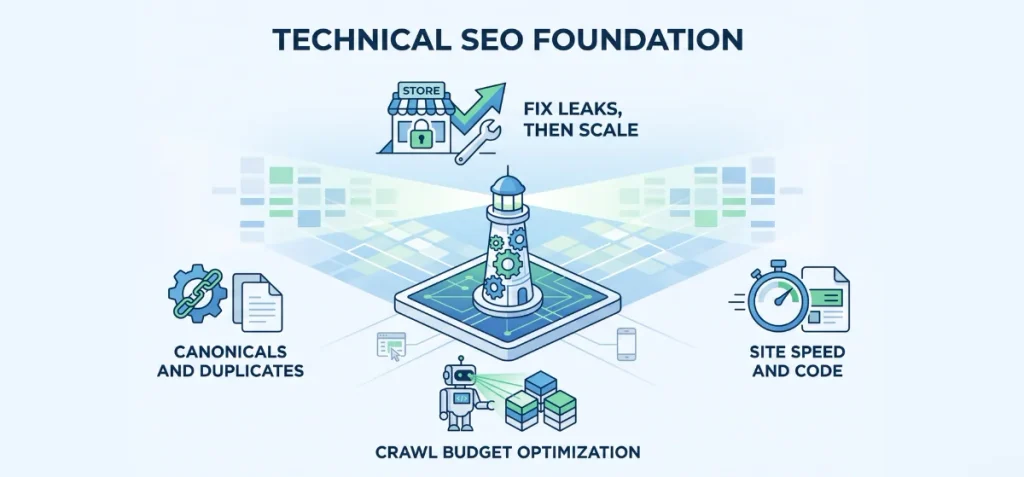
Many merchants try to fix flat sales by publishing dozens of articles. That effort fails when search engines can’t crawl your core catalog. Technical health always comes first.
Shopify handles some basic tasks. The platform automatically generates your sitemap and robots.txt files. It also places standard canonical tags in your theme header.
The real trouble starts with your theme code, custom apps, and product variations. Every winning case study tackles these specific technical leaks:
- Duplicate Product URLs: Shopify themes often link to products through collection paths like /collections/shirts/products/blue-shirt. The official canonical version lives at /products/blue-shirt.
When internal links point to collection-aware paths, crawlers waste time processing duplicate routes.
You can fix this by editing product-grid-item.liquid so internal links point straight to root product paths.
- Variant URLs and Canonicalization: Products with sizes, colors, or materials create unique URLs containing query parameters like ?variant=12345.
Your canonical tag must consistently point back to the main product URL. Without this fix, search engines index thin, near-identical pages.
- Filtered and Faceted URLs: Tag filters generate thousands of thin collection variations like /collections/shoes/red+size-10.
These waste your crawl budget. Lock these pages down by customizing your robots.txt.liquid file or applying clean noindex rules.
- Crawl Waste and Tag Bloat: Old tags create low-value index pages that show empty grids. Prune unused tags directly inside your Shopify admin to keep your index lean.
- Broken Links and 301 Redirects: Out-of-stock items, deleted products, and altered collections break incoming traffic.
Map old URLs to active, relevant collections using native Shopify URL redirects so authority stays intact.
- Site Speed: Bulky Liquid scripts and uncompressed hero banners drag mobile speeds down.
Clean out leftover code from uninstalled apps and convert graphics into responsive WebP formats.
- Structured Data: Search engines need clear machine signals. Add clean Product and BreadcrumbList markup directly into your theme code.
Source Guidance: Review the official Google Search Central documentation on canonicalization and the Shopify Help Center SEO overview to align your store setup with search engine requirements.
For detailed information, explore our dedicated Shopify plus strategy or audit your current site health with a professional Shopify plus SEO guide.
2. Map Keywords to the Right Shopify Page
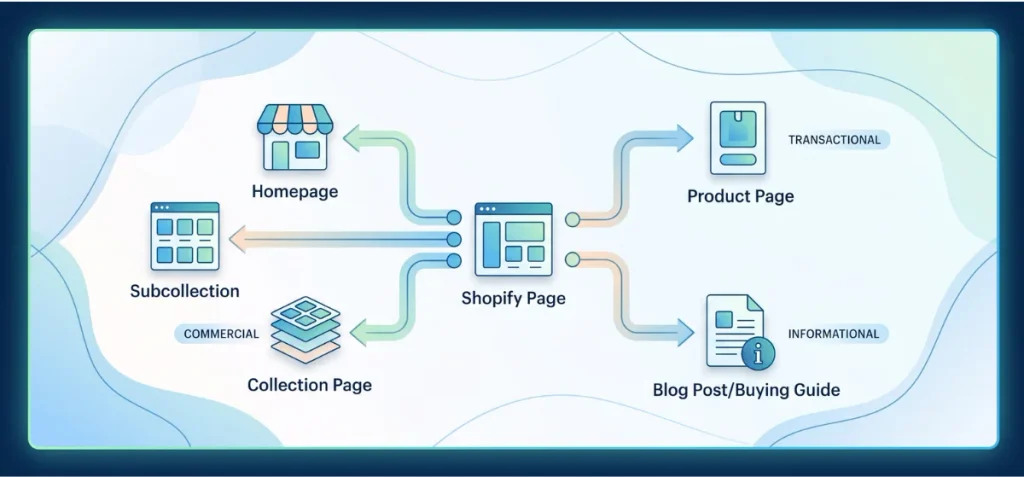
Traffic drops happen when you target queries with the wrong page type. You can write great copy, but a blog post will rarely rank for high-intent shopping queries. Shoppers want to buy, not read an essay.
Adam Riemer highlighted this exact issue in his e-commerce case studies. Stores often target transactional terms with informational blog posts.
When Google sees pure purchase intent, it displays collection grids instead. You must align your keyword mapping with how shoppers actually search.
Use this simple five-layer page hierarchy:
- Homepage → Brand and Core Entity: Your homepage represents your brand name and overarching identity. Target broad brand queries and primary market definitions here.
- Collection Pages → Category and Commercial Intent: Main collections serve broad category keywords like “leather boots” or “ceramic cookware.”
Shoppers use these commercial keywords to compare styles across your inventory.
- Subcollections → Specific Category and Use Case: Niche collections capture high-converting long-tail keywords.
Group products by specific use cases, such as “waterproof hiking boots” or “non-stick induction pans.”
- Product Pages → Product Keywords and Transactional Intent: Individual product pages capture narrow searches containing specific model names, colors, SKUs, and materials.
These visitors carry immediate transactional intent and want exact specifications.
- Blog Posts and Buying Guides → Informational and Evaluation Intent: Educational guides answer how-to questions, comparison queries, and sizing problems.
Use these pieces to guide early research and link shoppers toward appropriate collections.
Google shares this exact approach in its e-commerce search guidelines. Matching user intent to the correct URL prevents keyword cannibalization across your catalog.
If you want a step-by-step walkthrough on placing target terms inside your Shopify admin, read my complete guide on how to add keywords to Shopify website.
You can also check my full breakdown on how to get Shopify to rank for keywords to align your site taxonomy with real shopper demand.
3. Turn Collection Pages into SEO Assets
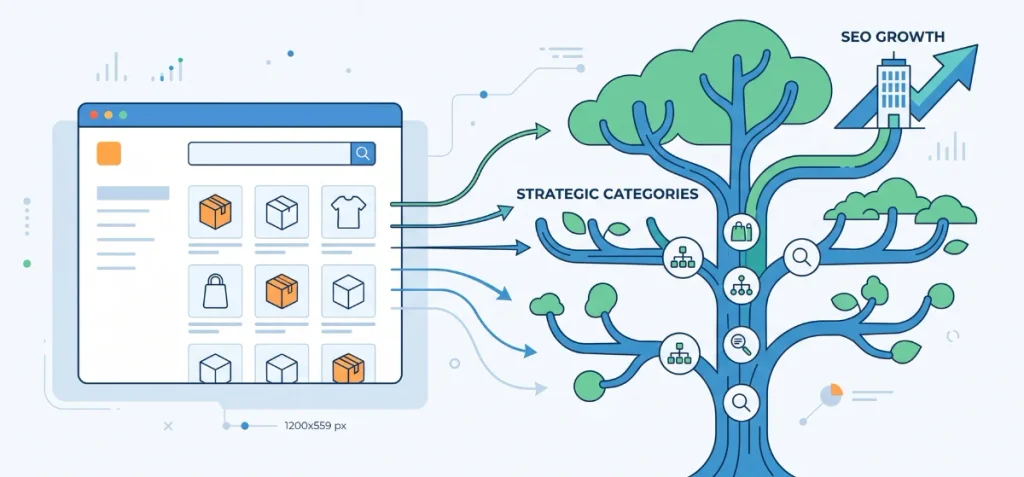
Some merchants treat collection pages like simple product grids. They drop in twenty products, add a generic title, and leave the page blank. This mistake kills organic growth.
Category pages drive the highest conversion rates across e-commerce. When you build them with intent, search engines reward your store with top rankings.
Oglesby Media proved this pattern with their surf shop client. The store originally dumped all gear into one catch-all wetsuit collection. The fix was simple.
They broke that single messy catalog into more than twenty targeted collections. They built subcategories for thickness, gender, season, and water temperature.
They also added brand-level collections for specific gear manufacturers based on real search queries. Organic traffic surged because every landing page matched exact customer searches.
Turn your collection pages into revenue drivers with these key steps:
- Build a Logical Category Hierarchy: Group your inventory like a physical department store. Guide shoppers smoothly from broad categories down to specific subcategories and individual items.
- Refine Subcategory Architecture: Never force all products onto one flat page. Create dedicated sub-collections for materials, fits, styles, and customer needs.
- Launch Brand Collections When Search Justifies It: Customers often shop by maker name. Create dedicated brand pages whenever shoppers search for specific manufacturers in your catalog.
- Write Unique Category Copy: Add original, helpful text to each collection. Place two or three concise sentences above the product grid to set context, then add detailed background information below the products.
- Add Practical Buying Guidance: Help buyers pick the right option directly on the collection page. Explain sizing differences, performance features, and care requirements so visitors don’t bounce.
- Include Real FAQs Only When Useful: Skip generic filler text. Answer three or four common customer objections about shipping, materials, or fit.
- Place Contextual Supporting Links: Link out to detailed sizing charts, maintenance guides, and related collections within your collection copy.
Google confirms this approach in its e-commerce search documentation. A clean structure from category to subcategory down to product helps search crawlers understand page relationships and topical depth.
You can test your collection text lengths and keyword placements using our free Shopify SEO Word Counter.
When you treat collections as primary landing pages, your store captures qualified shoppers before they ever click an ad.
4. Optimize Product Pages for Search + Conversion
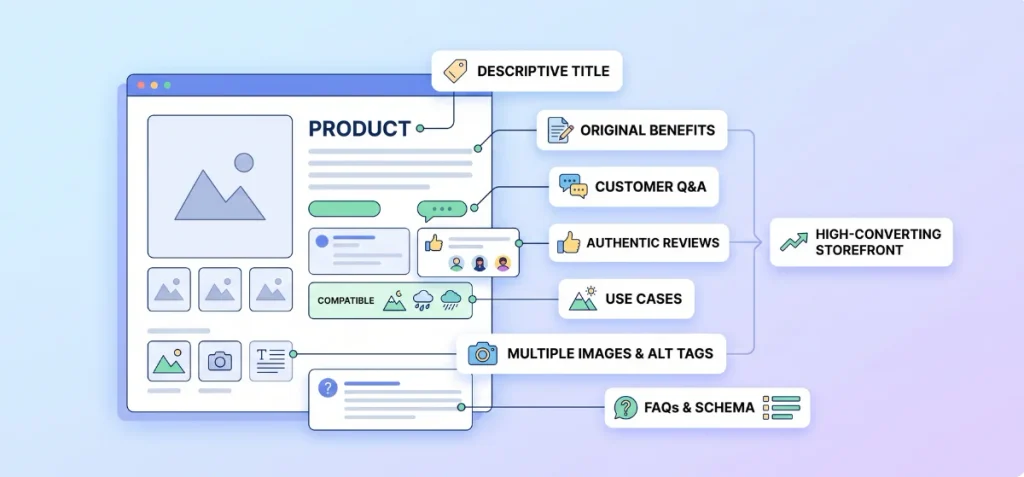
Product detail pages sit at the bottom of your sales funnel. When visitors land here, they are ready to swipe a card. Weak descriptions and stock manufacturer copy send those buyers right back to search results.
Every top case study treats product detail pages as dedicated sales letters. You need to answer every question a buyer might ask before they leave your tab.
Upgrade your product pages with these core optimizations:
- Write Descriptive Product Titles: Include the primary item name, material, core benefit, and key identifier. A title like “Men’s Merino Wool Trail Socks” outperforms a vague name like “Summit Series #4.”
- Craft Original Descriptions: Never copy and paste manufacturer blurbs. Write fresh copy that highlights real-world benefits, fabric feel, and durability.
- Address Common Customer Questions: Add clear information about sizing, dimensions, fit, and shipping timelines. Clear answers remove hesitation at checkout.
- Feature Authentic Customer Reviews: Display real customer feedback and user-submitted photos. User reviews add fresh keyword variations naturally while building social proof.
- Highlight Compatibility and Use Cases: Tell shoppers how the item performs in different situations. Specify whether a replacement part fits certain models or if a jacket works in heavy rain.
- Optimize Images and Alt Text: Upload high-resolution photos from multiple angles. Write descriptive alt tags for every image so search crawlers can index your visual assets accurately.
- Add Helpful FAQs: Answer common maintenance questions, return rules, and care instructions near the bottom of the page.
- Implement Rich Product Structured Data: Add clean schema markup so search engines understand your pricing, availability, and review stars.
Use modern schema standards across your theme code. Google’s documentation supports Product markup for standalone items and ProductGroup structured data for multi-variant products.
This markup helps search engines read your sizes, colors, and inventory levels without confusing distinct SKUs.
If you want your catalog copy written for higher conversions and top search rankings, explore my Shopify product page copywriting services to turn basic listings into high-converting storefronts.
5. Build Supporting Content Around Buyer Problems
Random blogging doesn’t grow store revenue. Publishing twenty lifestyle articles about unrelated topics only wastes your time and budget. Every single article must serve a specific business purpose.
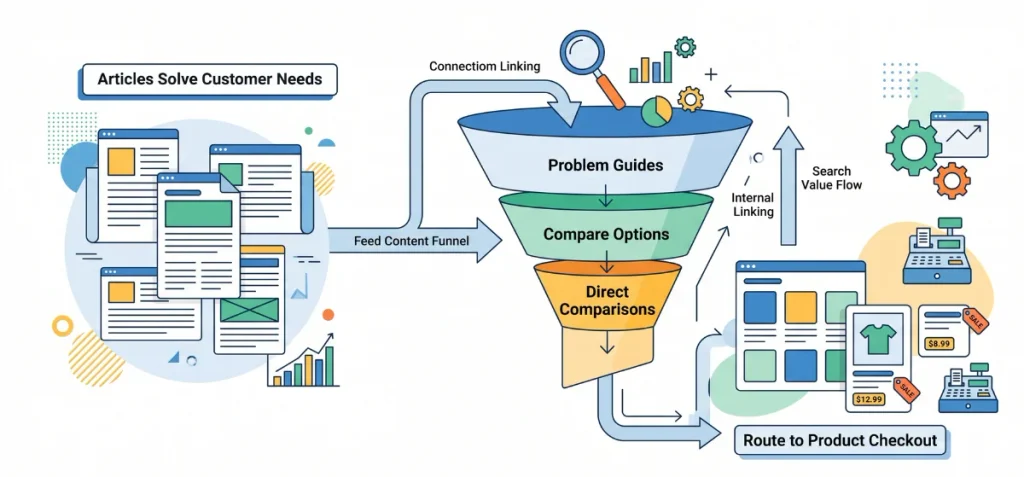
Top e-commerce campaigns build content funnels that feed directly into commercial pages. Break The Web and Adam Riemer both stress this rule in their case studies.
Blog posts should never live on an isolated content island. They exist to guide shoppers from early research down to your cash register.
Structure your content topics around this simple four-step buyer journey:
- Step 1: Identify the Customer Problem: Start with educational guides that solve immediate customer pain points.
- Step 2: Guide the Evaluation Process: Compare options based on specific customer needs and use cases.
- Step 3: Present Direct Comparisons: Address shoppers near the finish line who need help picking between two models. Write head-to-head guides.
- Step 4: Funnel Directly into Collections and Products: Route readers directly into targeted collection pages and finally to individual product checkout pages.
This progression connects your topical authority directly to your money pages. Strategic internal links pass search value upward while giving readers a seamless path to buy.
If you want structured content clusters that drive steady organic sales, check out my specialized SEO content writing for Shopify to build articles that actually support your catalog.
6. Build Authority Where It Matters
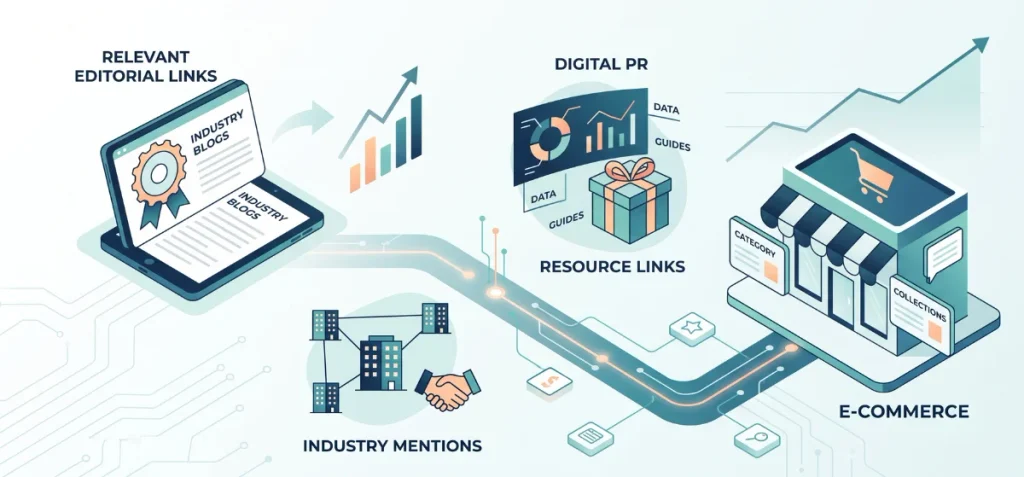
Links work as votes of trust, but quality beats sheer volume every time. Spamming directories with generic links accomplishes nothing. Real growth comes from relevant mentions across reputable industry publications.
Focus your outreach on signals that move search rankings:
- Relevant Editorial Links: Earn features inside industry blogs and niche publications where your target audience reads.
- Digital PR: Pitch unique store data, seasonal buying trends, or original product surveys to journalists.
- Resource Links and Buying Guides: Get your brand included in trusted gift guides, roundups, and educational resource lists.
- Industry Mentions: Secure citations on supplier partner pages, trade associations, and manufacturer directories.
- Natural Backlinks to Commercial Pages: Point external links toward top-level category pages and flagship collections.
A crucial counterpoint exists across successful case studies. More backlinks don’t automatically explain every traffic surge.
Adam Riemer explicitly documented an e-commerce campaign that succeeded with zero conventional outreach. His team drove major ranking gains purely through internal links, category cleanup, and intent alignment.
On the flip side, SeoProfy credited their massive traffic surge on Trendy Toddlers partly to a big jump in referring domains, growing their link profile from 9 to over 680 unique domains.
Both approaches work. If your technical setup and site architecture are solid, clean links accelerate your results. If your site structure is broken, no amount of link building will save your store.
How to Read a Shopify SEO Case Study Without Getting Fooled
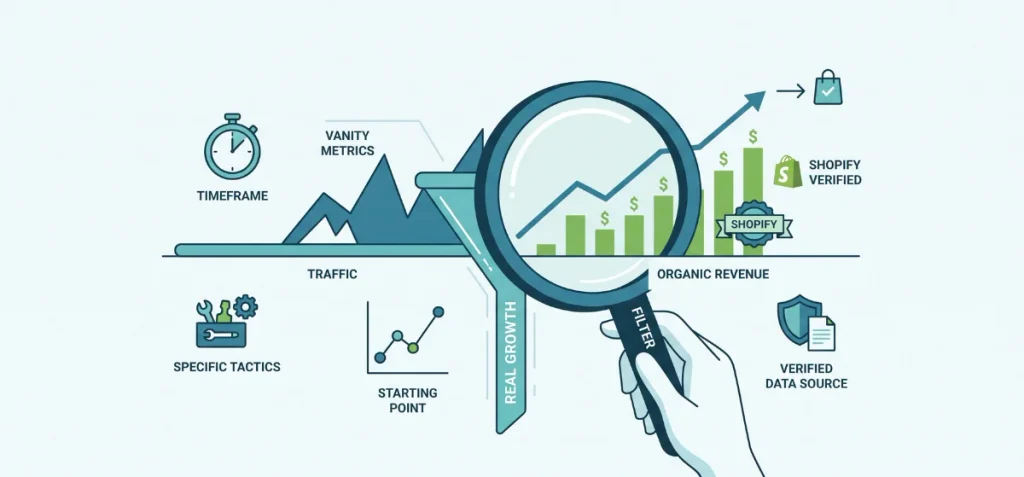
Marketing agencies often hide weak results behind flashy traffic graphs.
You need a filter to tell the difference between genuine revenue wins and empty vanity metrics. Apply these five questions to any SEO claim to uncover the real story:
1. What Was the Starting Point?
A jump to 47,000 monthly visits looks incredible on paper. But jumping from 100 to 47,000 visits tells a very different story than climbing from 40,000 to 47,000. Big percentages mean nothing without clear baseline context.
2. What Exactly Changed?
Look past vague claims like “we optimized the site.” Demand specifics. Did the agency execute technical crawl cleanups?
Did they rebuild category structures? Did they launch an aggressive link-building campaign? You need to know the exact mechanics driving the results.
3. How Long Did It Take?
Timeframes matter. Building genuine organic authority takes months of compounding effort.
A case study showing massive gains in just three weeks usually involves paid traffic surges, seasonal spikes, or a recovery from a technical penalty, not new organic growth.
4. What Was the Measurement Source?
Always check where the numbers come from. Reliable case studies cite primary data sources. Benson SEO reports verifiable impressions and click data straight from Google Search Console.
Vague estimates from third-party SEO tools rarely reflect true site performance.
5. Did Revenue Increase or Only Traffic?
This is the ultimate test. Traffic without sales is worthless. Did the organic clicks turn into checkout sessions?
The iWebPower case study proves its value by showing a jump from $590K to $1.205M in organic revenue, verified directly inside Shopify backend tracking. Pure traffic gains don’t pay the bills; organic revenue does.
What Shopify SEO Case Studies Reveal About Google AI Overviews
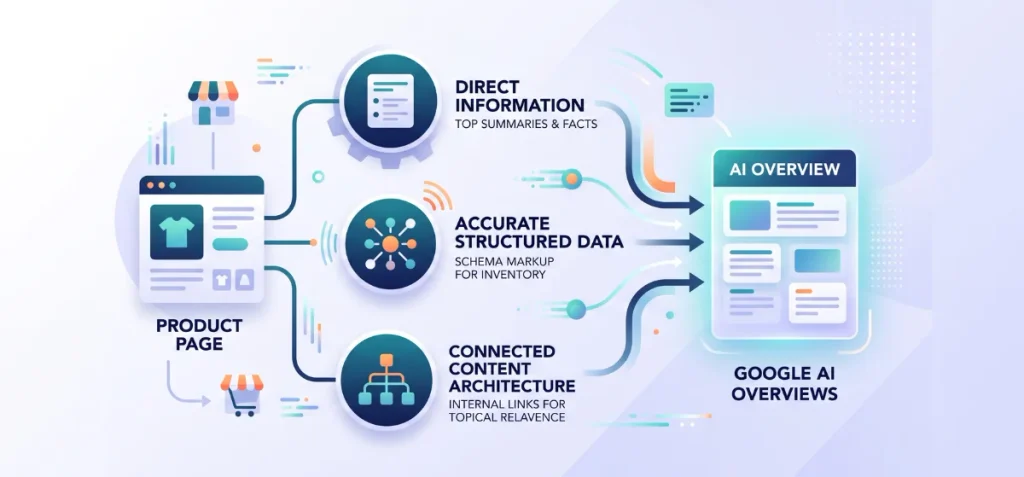
Google states plainly that store owners don’t need a separate SEO playbook for AI Overviews. Traditional search fundamentals remain the foundation for all machine summaries.
Modern search engines use automated systems to scan and extract page content. Clear, concise copy helps these models understand your products instantly.
You do not need to rewrite your entire catalog for artificial intelligence. Instead, build a solid commercial structure that machines can read with ease.
Three core components drive your visibility in AI-generated answers:
- Clear, Direct Information: Place short, factual summaries near the top of collections and product descriptions. Answer pricing, sizing, and material questions without promotional filler.
- Accurate Structured Data: Add detailed schema markup across your inventory. Clean machine signals tell search engines your exact stock levels, prices, and variant attributes.
- Connected Content Architecture: Build tight internal links between educational guides and catalog pages. Strong topical relationships help search models connect user problems directly to your inventory.
Treat AI Overviews as an extra search surface, not a replacement for classic search visibility. The 2026 Bread Garden case study illustrates this distinction clearly.
The Singapore bakery already held top-five rankings for key seasonal products. Their core organic rankings stayed largely stable, yet their organic clicks surged when AI Overviews expanded across their market.
Search engines pulled their structured catalog facts straight into generated summaries, driving a ninefold increase in click-through rates.
This example isn’t universal proof that AI guarantees more traffic everywhere. It shows that answer engines reward stores with clean data and high topical relevance.
If you want to position your product listings for both traditional search and modern answer engines, explore my AI and LLM optimization services to future-proof your catalog.
How to Apply These Shopify SEO Lessons to Your Store
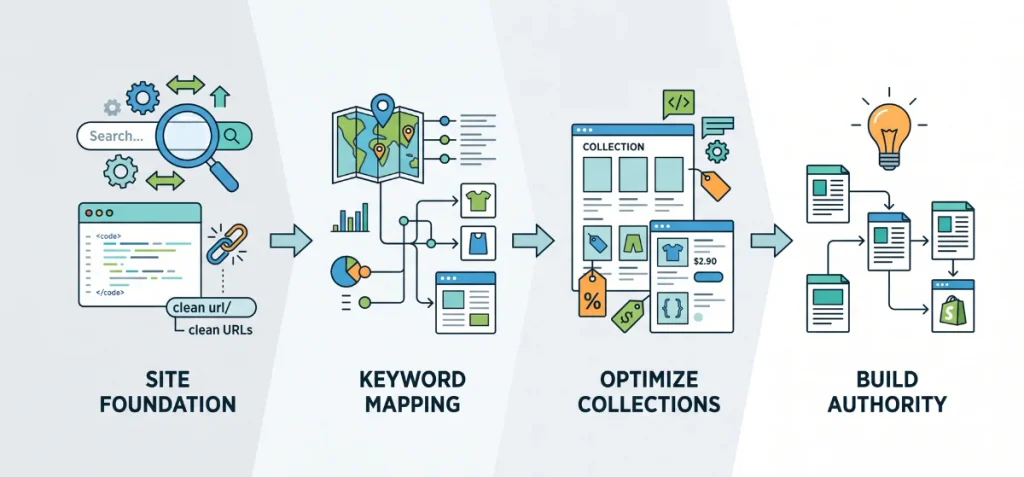
Order matters when you fix a store. You throw money away if you buy links while your site leaks crawl budget.
Take this step-by-step path to turn things around:
Week 1: Audit Your Crawl and Index Health
Open Google Search Console first. Hunt down 404 errors, dead links, and duplicate paths.
Stop your theme from generating messy collection-aware URLs. Clean out empty tag pages so Google scans only your best products.
Week 2: Map Keywords to the Right URLs
Match every search phrase to the correct page type. Put category terms on collection pages. Put exact product names on product pages. Never target buying terms with blog posts.
Weeks 3–4: Polish Core Collections and Products
Pick your top ten money-maker collections. Add clear introduction copy, smart subcategories, and proper schema code.
Update your best product pages next. Write original descriptions, add real customer answers, and optimize variant data.
Month 2 and Beyond: Add Problem-Solving Guides
Answer the exact questions your shoppers ask before they buy. Tie each guide straight to a relevant collection page with clear links. These articles feed authority into your catalog and push readers toward checkout.
Ongoing Work: Build Authority and Refresh Content
Reach out to suppliers and niche publications for honest mentions. Check your real sales and conversion numbers inside GA4 and Shopify. Update seasonal copy and redirect out-of-stock items so your links stay fresh.
Nobody can guarantee first-page rankings in 30 days. Google takes time to crawl, process, and rank new pages. Some site fixes show results in weeks, while deep category changes take months.
Every store starts from a different spot, so focus on steady execution instead of overnight miracles.
You can set up clean foundations right from day one with my guide on how to start a Shopify store. If your store is already live, test my favorite playbook on how to market Shopify store to bring in qualified buyers.
Which Shopify SEO Metrics Actually Matter?
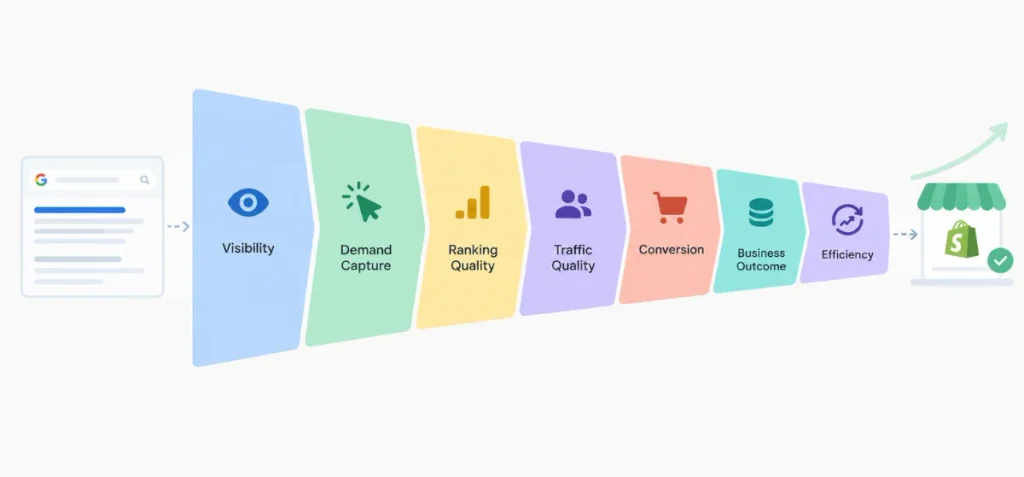
Rankings look great in client slide decks, but rankings alone don’t pay your staff. You can’t run a profitable business on impressions and vanity metrics.
Track your growth with this simple six-step performance funnel:
- Visibility → Impressions: Google sees your store and places your URLs in search results. Check Google Search Console to confirm your catalog expands across relevant terms.
- Demand Capture → Clicks and Click-Through Rate (CTR): Shoppers see your title tags in search results and choose your link over competitors. Low clicks on high impressions mean your titles need work.
- Ranking Quality → Top 3 and Top 10 Commercial Terms: High positions on buying keywords drive the highest buyer intent. Track where your collection pages sit for non-branded product terms.
- Traffic Quality → Non-Branded Organic Sessions: People who don’t know your brand find you through pure product searches. Check GA4 to separate brand searches from real discovery traffic.
- Conversion → Organic Conversion Rate (CVR): Organic visitors must turn into paying buyers at checkout. If sessions spike while sales stay flat, your page copy or pricing might miss the mark.
Calculate your target margins with our product selling price calculator to keep profits healthy.
- Business Outcome → Organic Revenue: Cash in your bank account is the true test of your store. Check the Shopify analytics dashboard to see your exact organic sales dollars.
- Efficiency → SEO ROI and Customer Acquisition Cost (CAC): Compare your organic revenue against your optimization costs. Good search traffic lowers your paid ad costs and lifts your net margins over time.
Focus on the bottom of this funnel. When your non-branded sessions turn into real checkout orders, your store wins.
To Conclude
Every verified case study SEO for store Shopify points to one truth. Organic growth is not magic. It comes from clean code, sharp category layouts, and pages that answer buyer questions directly.
Fix your technical leaks first. Map your keywords to the right pages, and treat your collection pages like true storefronts.
If you want an experienced partner to scale your catalog, our team provides proven Shopify SEO services to grow your sales.
FAQs
How Can SEO Increase Shopify Organic Traffic?
Good SEO helps search engines discover your products. Clean technical code, fast speeds, descriptive metadata, and targeted collection pages place your store directly before active buyers.
How Long Does Shopify SEO Take to Show Results?
Most stores see early traffic within three to six months. Tough competitive niches, brand-new domains, and major revenue shifts take six to twelve months of steady execution.
Which Shopify Pages Should I Optimize First?
Start with your primary collection pages and top ten best-selling products. These high-intent pages drive immediate revenue. Leave informational blog posts for later once core money pages convert.
How Do I Measure Shopify SEO ROI?
Subtract total SEO expenses from your organic sales, divide by those costs, and multiply by 100. Track organic checkout value inside your Shopify analytics dashboard to confirm real profit.